
REPORT | Education for Displaced Students: Celebrating a milestone with Maung Sawyeddollah

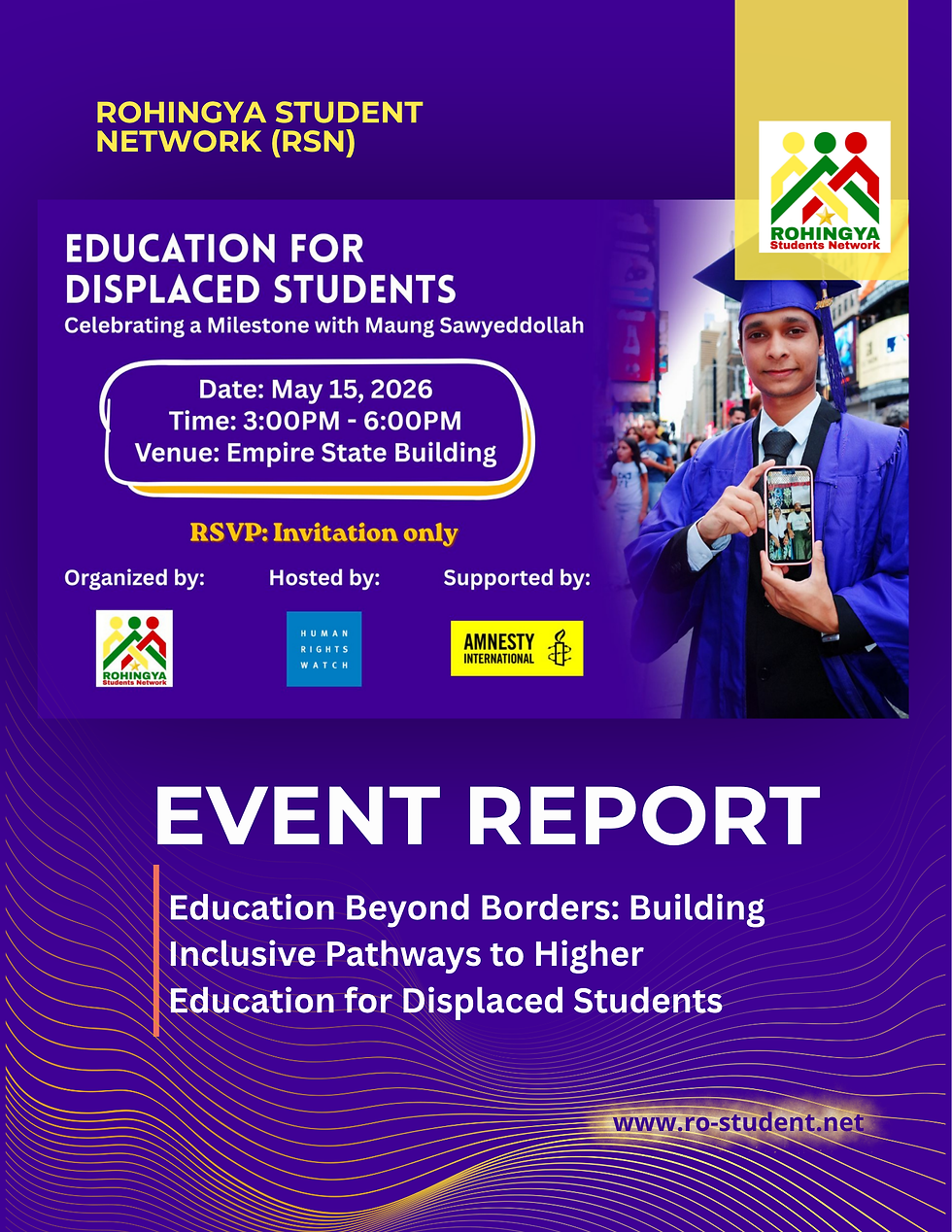

Education for Displaced Students: Celebrating a milestone with Maung Sawyeddollah
This report is fully prepared by Rohingya Student Network (RSN).
Executive Summary
On 15 May 2026, the Rohingya Student Network (RSN), hosted by Human Rights Watch (HRW) and supported by Amnesty International, convened a high-level event titled Education for Displaced Students: Celebrating a milestone with Maung Sawyeddollah at Human Rights Watch headquarters in New York City.
The event brought together 43 participants in person and 62 participants virtually from 12 countries, including representatives from diplomatic missions, universities, civil society organizations, refugee-led initiatives, human rights organizations, and displaced communities. The majority of virtual participants joined from Rohingya refugee camps in Cox’s Bazar, Bangladesh.
The event marked the graduation of Maung Sawyeddollah from New York University, making him the first known Rohingya student from the refugee camps in Bangladesh to complete a bachelor's degree at a university in the United States. While this achievement served as the catalyst for the gathering, the event's primary purpose was to examine broader barriers to higher education faced by displaced and stateless students and identify pathways toward more inclusive educational systems.
Speakers highlighted persistent obstacles including statelessness, lack of legal documentation, mobility restrictions, financial barriers, discrimination, inadequate educational infrastructure, and limited access to accredited learning opportunities. At the same time, participants showcased promising initiatives led by refugee communities, civil society organizations, universities, and international partners.
The event concluded with a collective call for governments, donors, universities, international organizations, and philanthropic institutions to strengthen investments in higher education for Rohingya and other displaced populations and support refugee-led educational solutions.
Key Messages and Recommendations
Key Messages
Higher Education Remains One of the Largest Gaps in Refugee Response
Despite global commitments to inclusive education, access to tertiary education remains unavailable to Rohingya and most displaced and stateless youth. Barriers include lack of documentation, financial constraints, mobility restrictions, language barriers, and limited scholarship opportunities.
Educational Exclusion Has Long-Term Consequences
Participants emphasized that denying access to higher education contributes to cycles of poverty, dependency, and marginalization. Educational access strengthens leadership, economic participation, social cohesion, and long-term stability.
Refugee-Led Educational Initiatives Are Critical
Speakers highlighted the important role of community-led schools, teacher training initiatives, and refugee-led organizations in responding to educational gaps. These efforts demonstrate resilience and innovation but remain significantly under-resourced.
Access Requires More Than Scholarships
While financial support is essential, Rohingya students often face additional barriers including documentation requirements, visa restrictions, housing challenges, language barriers, and limited professional networks. Comprehensive support systems are needed to ensure student success.
Education Is an Investment in Peace and Leadership
Participants repeatedly emphasized that investing in education for Rohingya and other displaced youth is not solely a humanitarian obligation. It is also an investment in future leaders, professionals, educators, entrepreneurs, and peacebuilders who can contribute to their communities and societies.
Recommendations
For Governments
Expand pathways allowing Rohingya students to access higher education.
Reduce documentation barriers affecting university admissions.
Recognize higher education as an integral component of refugee protection.
For Universities
Create dedicated scholarship programs for Rohingya students.
Develop flexible admissions procedures for applicants lacking traditional documentation.
Partner with refugee-led organizations to identify and support qualified students.
For Foundations and Donors
Increase funding for higher education initiatives serving Rohingya people.
Support refugee-led educational programs and institutions.
Invest in mentorship, leadership development, and long-term educational support systems.
For International Organizations
Integrate tertiary education into refugee response frameworks.
Support accreditation and certification pathways.
Ensure meaningful participation of Rohingya in educational decision-making.
Table of Contents
Key Messages and Recommendations
3. Participation and Representation
3.1 Government Official Myanmar NUG Ministry of Human Rights
3.3 International Organizations and Civil Society
3.5 Refugee-Led and Community Organizations
4.1 Higher Education as a Human Right
4.2 Educational Exclusion as a Structural Challenge
4.3 From Displacement to Higher Education
5. Perspectives from International Partners
6. Community-Led Educational Solutions
7. Women's Access to Higher Education
8. Emerging Opportunities and Partnerships
9. Diverse Policy Perspectives

1. Background
Access to higher education remains one of the most neglected dimensions of the global refugee response. While considerable efforts have focused on primary and secondary education, tertiary education opportunities remain inaccessible to most displaced youth worldwide.
For Rohingya students, educational exclusion has been particularly severe. Decades of discriminatory policies in Myanmar, combined with statelessness, displacement, and restrictions on movement and documentation, have created significant barriers to educational advancement.
In September 2025, during the United Nations General Assembly High-Level Conference on the Situation of Rohingya Muslims and Other Minorities in Myanmar, Maung Sawyeddollah emphasized the urgent need to expand higher education opportunities. This event was organized as a continuation of that conversation and sought to bring together key stakeholders to discuss practical pathways forward.
2. Event Objectives
The event sought to:
Promote higher education as a fundamental right for displaced and stateless students.
Highlight educational barriers faced by Rohingya and other displaced youth.
Showcase successful educational pathways and emerging initiatives.
Facilitate dialogue among policymakers, universities, donors, and refugee communities.
Encourage investment in sustainable and inclusive higher education opportunities.
3. Participation and Representation
The event brought together representatives from:
3.1 Government Official Myanmar NUG Ministry of Human Rights
Ministry of Human Rights (Myanmar NUG)
3.2 Diplomatic Missions
Permanent Mission of Bangladesh to the United Nations
Permanent Mission of Denmark to the United Nations
Permanent Mission of Comoros to the United Nations
3.3 International Organizations and Civil Society
Human Rights Watch
Amnesty International
Legal Action Worldwide
Independent Diplomat
Justice For All
3.4 Educational Institutions
New York University
Japan ICU Foundation
Asian University for Women (represented through alumni participation)
3.5 Refugee-Led and Community Organizations
Rohingya Student Network (RSN)
Arakan Rohingya Society for Peace and Human Rights (ARSPHR)
Arakan Rohingya Union (ARU)
Arakan Youth Peace Network (AYPN)
Refugee Women for Peace and Justice
3.6 Geographic Representation
Participants joined from Bangladesh, Myanmar, the United States, Canada, Australia, India, Indonesia, Laos, Malaysia, Saudi Arabia, and other countries.
4. Key Themes and Discussions
4.1 Higher Education as a Human Right
Throughout the event, speakers emphasized that access to higher education should be recognized as a fundamental human right rather than a privilege available only to those with citizenship, financial resources, or legal documentation.
Participants repeatedly highlighted that educational exclusion contributes to cycles of poverty, marginalization, and vulnerability. They stressed that access to quality education strengthens leadership, social inclusion, economic participation, and long-term stability.
As one speaker noted:
“Education is not a privilege for some; it is a human right that was systematically denied to us to ensure our marginalization.” Mohammed Nowkhim, ARSPHR
4.2 Educational Exclusion as a Structural Challenge
Speakers described how restrictions on education have historically functioned as tools of exclusion against Rohingya communities.

Mohammed Nowkhim reflected on how educational opportunities disappeared for many Rohingya students following discriminatory policies in Myanmar. He emphasized that educational denial was not accidental but formed part of a broader system that restricted citizenship, political participation, and social mobility.
Similarly, Rofik Husson shared his experiences growing up in Myanmar's education system, where Rohingya students often faced segregation, discrimination, and exclusion. He described educational barriers as part of a wider effort to weaken communities and restrict future opportunities.
Aung Kyaw Moe, deputy minister of the Ministry of Human Rights of the Myanmar National Unity Government, shared the importance of education for the displaced students in Myanmar, particularly the Rohingya students.
These perspectives reinforced the importance of viewing educational access not only as a development issue but also as a human rights concern.
4.3 From Displacement to Higher Education
A central discussion focused on the educational journey of Maung Sawyeddollah. After fleeing Myanmar during the 2017 atrocities and living in the refugee camps of Bangladesh, he faced significant barriers to accessing university education. Following unsuccessful attempts to pursue higher education in Bangladesh, he applied to more than 150 universities internationally before receiving admission to New York University.
His experience highlighted several common barriers faced by displaced students:
Lack of recognized legal documentation.
Financial constraints.
Mobility restrictions.
Administrative barriers.
Discrimination based on identity.
His story also demonstrated the importance of institutional support, scholarships, mentorship, and international solidarity.

5. Perspectives from International Partners
5.1 Human Rights Watch
Through remarks delivered by Bill Van Esveld and Katherine Puente, Human Rights Watch highlighted continuing concerns regarding access to quality and accredited education for Rohingya children and youth.
Bill Van Esveld emphasized that educational access remains severely limited and argued that refugee communities should play a greater role in shaping educational policies and programs. He also drew attention to community-led schools established by Rohingya educators and encouraged greater support for these initiatives.
One of the most memorable observations from his remarks was:
“Every single step he [Maung Sawyeddollah] has taken was officially impossible.” Bill Van Esveld, Human rights watch
This statement captured the broader challenge facing displaced students around the world.
5.2 Amnesty International
Damini Satija of Amnesty International reflected on years of collaboration with Rohingya advocates and emphasized the relationship between human rights, accountability, and educational access.
Her remarks highlighted the often-invisible barriers displaced students face, including legal obstacles, documentation requirements, mobility restrictions, and financial challenges.
She stressed that meaningful educational inclusion requires more than scholarships alone; it requires systems capable of supporting students throughout their educational journeys.
5.3 Young Activist Summit
Marina Wutholen, Founder of the Young Activist Summit, highlighted the importance of investing in young leaders from marginalized communities.
She emphasized that displaced youth possess significant leadership potential and that educational opportunities can create pathways for broader social impact and community transformation.
6. Community-Led Educational Solutions
Several speakers emphasized the importance of refugee-led initiatives. Osamah Siddique presented the Arakan Rohingya Union's Rohingya Education System (RES), a community-led educational initiative designed to strengthen access to learning opportunities within refugee camps.
The initiative includes:
Teacher training programs.
Curriculum development.
Community-based educational delivery.
Planned pilot implementation across several refugee camps.
The presentation demonstrated how refugee communities are developing practical solutions despite limited resources and institutional support.
7. Women's Access to Higher Education
Lucky Karim highlighted the importance of educational opportunities for Rohingya women and girls. Her remarks drew attention to institutions such as the Asian University for Women, which have provided critical educational opportunities for refugee women who otherwise face significant barriers to higher education

8. Emerging Opportunities and Partnerships
The event showcased several promising developments.
Scholarship Pathways: Aki Takada of the Japan ICU Foundation shared efforts to explore scholarship opportunities for Rohingya students through language schools and educational institutions in Japan.
Community-Based Education: The Arakan Rohingya Union presented plans to expand educational programming through its Rohingya Education System initiative.
International Collaboration: The event demonstrated growing interest among universities, foundations, civil society organizations, and refugee-led initiatives to work collaboratively on educational access and leadership development.
9. Diverse Policy Perspectives
The event also provided space for constructive dialogue among different stakeholders. Representatives of the Permanent Mission of Bangladesh acknowledged the importance of education and highlighted recent teacher training initiatives involving Rohingya educators. They also emphasized the need to address the root causes of displacement in Myanmar and encouraged continued dialogue on educational challenges. This exchange illustrated the importance of engaging multiple perspectives while maintaining a shared commitment to improving educational opportunities for displaced populations.
10. Conclusion
The event demonstrated that while barriers to higher education remain significant, meaningful progress is possible through collaboration among governments, universities, donors, civil society organizations, and refugee communities.
The discussions highlighted both the scale of the challenge and the existence of practical solutions. Speakers repeatedly emphasized that educational opportunities should not be exceptional achievements available only to a small number of individuals. Rather, they should become accessible pathways available to all qualified displaced students.
The graduation of Maung Sawyeddollah served as a powerful example of what becomes possible when determination is matched with opportunity, support, and international cooperation. Yet the broader message of the event extended far beyond one individual's achievement. The event called on stakeholders across sectors to work collectively toward a future in which displaced students everywhere have equitable access to quality higher education and the opportunity to contribute fully to their communities and societies.
Annex A: Speakers and Contributors
1. Mr. Maung Sawyeddollah, Rohingya Student Network
2. Ms. Katherine puente, Human Rights Watch
3. Mr. Bill Van Esveld, Human Rights Watch
4. Ms. Marina Wutholen, Young Activist Summit
5. Ms. Damini Satija, Amnesty International
6. Ms. Danielle Robay, Journalist
7. Professor Bindu Dulock, New York University
8. Mr. Mohammed Nowkhim, Arakan Rohingya Society for Peace and Human Rights
9. Ms. Lucky Karim, Refugee Women for Peace and Justice
10. Mr. Rofik Husson, Arakan Youth Peace Network
11. HE U Aung Kyaw Moe, National Unity Government
12. Mr. Osamah Siddique, Arakan Rohingya Union
13. Ms. Aki Takada, Japan ICU Foundation
14. Ms. Farida Yasmeen, Bangladesh mission to the UN
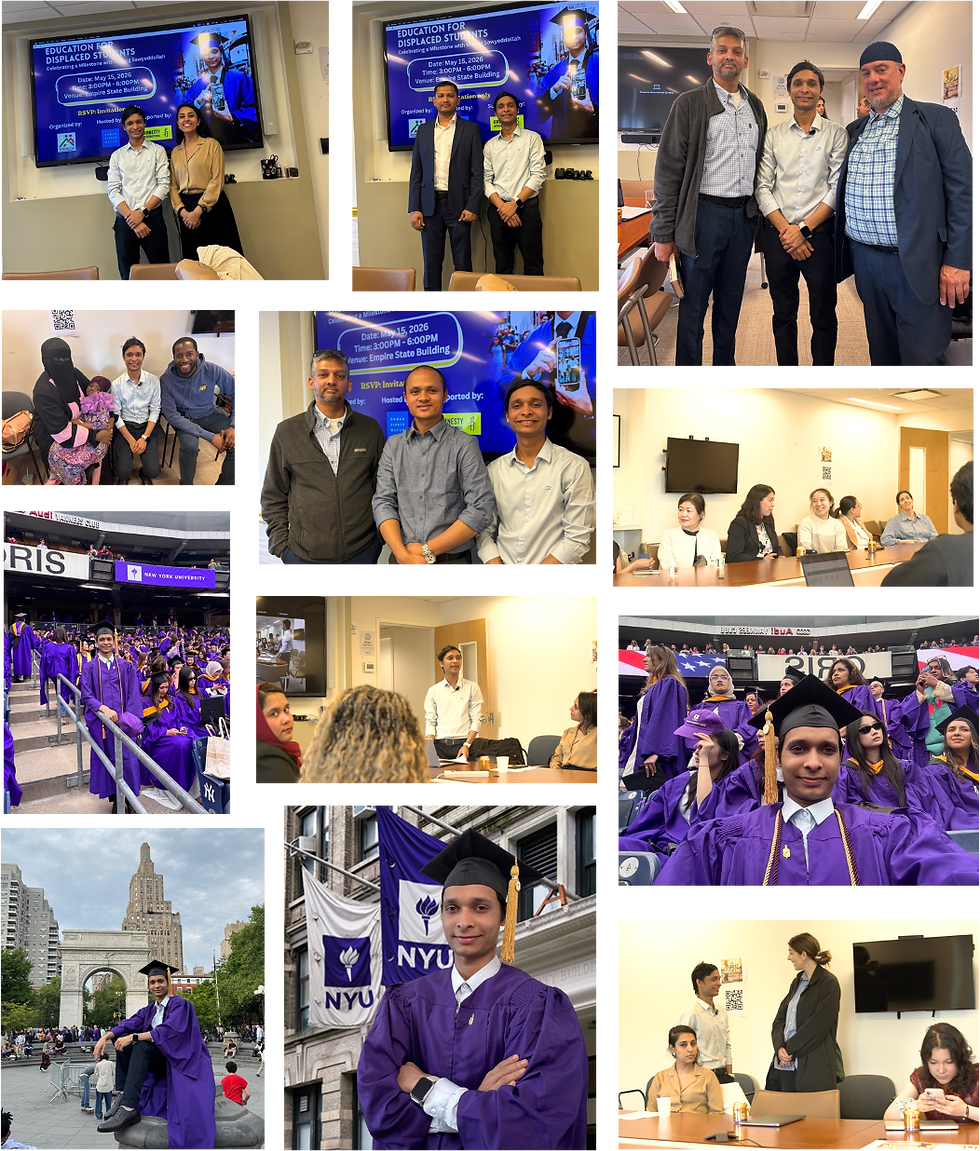
Annex B: Photo Gallery



Comments